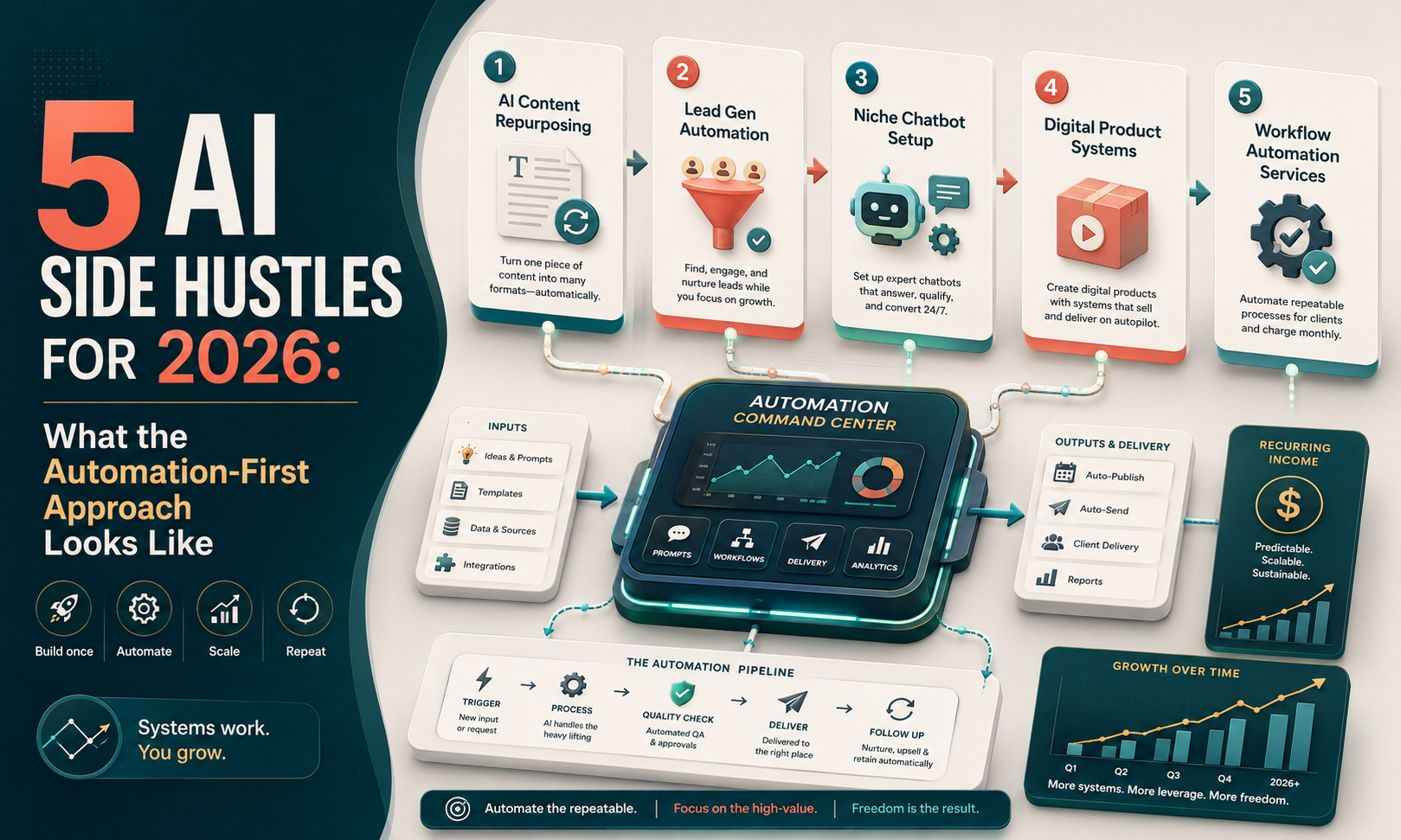
5 AI Side Hustles for 2026: What the Automation-First Approach Looks Like
The promise of AI as operational leverage has been around for a while, but the specific applications keep evolving. In a recent video, the channel Michael Invests outlined five AI side hustles aimed at 2026, each built around the idea of automating services rather than trading time for money. The video itself doesn't provide revenue figures or detailed case studies, but the concepts are worth examining for anyone exploring AI-driven micro-services.
What Happened
Michael Invests published a video titled "5 AI Side Hustles to Make Money Online in 2026" on July 21, 2026. The video presents a framework for using AI and automation to create scalable income streams. The five side hustles proposed are:
1. Automated Video Dubbing and Translation – Offer localization services for global brands using AI dubbing tools.
2. Programmatic Advertising for Local Businesses – Set up and manage automated ad campaigns for small businesses.
3. Niche Handbooks – Create and sell AI-generated digital handbooks on specific topics.
4. Workflow Systems – Build and sell custom automation workflows for businesses.
5. Short-Form Curation for Executives – Curate and summarize industry news and content for busy professionals.
The common thread: use AI to replace manual labor and deliver services at scale. No specific revenue claims or client examples are given in the description.
AI Tools Used
While the video description does not name specific tools, automation platforms like Make (formerly Integromat) are commonly used to build such workflows. Other tools that fit these side hustles include:
• AI video dubbing/translation: Rask.ai, HeyGen, Synthesia
• Programmatic advertising: Google Ads automation, Adzooma, AdEspresso
• Content generation: ChatGPT, Claude, Jasper
• Workflow automation: Make, Zapier, n8n
These are editorial inferences based on the described services, not direct endorsements from the source.
How It Works
The video breaks each side hustle into a simple service offering, but execution details are missing. Based on the description, here's a logical workflow for each:
| Side Hustle | Typical Workflow (Editorial) |
|---|---|
| Automated Video Dubbing & Translation | Client provides raw video → AI transcribes → translates into target language → voiceover/generated voice → deliver dubbed video |
| Programmatic Advertising for Local Businesses | Identify local business → set up automated ad campaigns → monitor and optimize → charge monthly retainer |
| Niche Handbooks | Research niche → use AI to generate content → compile into ebook → sell on Gumroad or Amazon KDP |
| Workflow Systems | Identify repetitive business task → build automation with Make/Zapier → sell as a template or managed service |
| Short-Form Curation for Executives | Use AI to scan news sources → summarize key points → deliver daily/weekly email digest → charge subscription |
These workflows are not confirmed by the source but are reasonable extrapolations.
Business Opportunity
Each side hustle targets a specific market need. For solo builders, the appeal is low startup cost—most can be started with existing AI subscriptions and a laptop. The business models are primarily service-based (charging per project or retainer) or productized (selling handbooks or templates).
• Video dubbing is well-suited for creators or agencies targeting global brands. The barrier is client trust and quality control.
• Programmatic advertising requires some ad platform expertise, but AI can handle optimization. Local businesses are a large but price-sensitive market.
• Niche handbooks are low-effort, but competition is high. Success depends on picking a unique niche and effective marketing.
• Workflow systems have high perceived value for businesses, but sales cycles can be long.
• Short-form curation is a classic info-product model; AI makes it faster, but differentiation is tough.
Confirmed facts: The video describes these as viable side hustles. Editorial analysis: None of these are guaranteed income streams. They require marketing, client acquisition, and ongoing effort. Revenue potential varies widely.
Key Takeaways
1. Start with one side hustle – Master a single service before diversifying. Trying to do all five at once will dilute your focus.
2. Use automation wisely – Tools like Make can handle repetitive tasks, but don't automate relationship-building. Clients still need human oversight.
3. Differentiate or commoditize – Generic AI services are easy to copy. Find a niche where you can add unique value, such as industry expertise or faster turnaround.
4. Test before scaling – Offer your service to a few clients at a low rate to refine your process. Only after validation should you invest in marketing.
5. Watch out for risks – No income guarantees. Client dependency, platform changes, and competition are real. Keep your day job until you have consistent revenue.
These five concepts are a useful starting point for brainstorming, but treat them as hypothesis, not a blueprint.
Original video
This article is based on the original YouTube video from Michael Invests. Watch the source here: