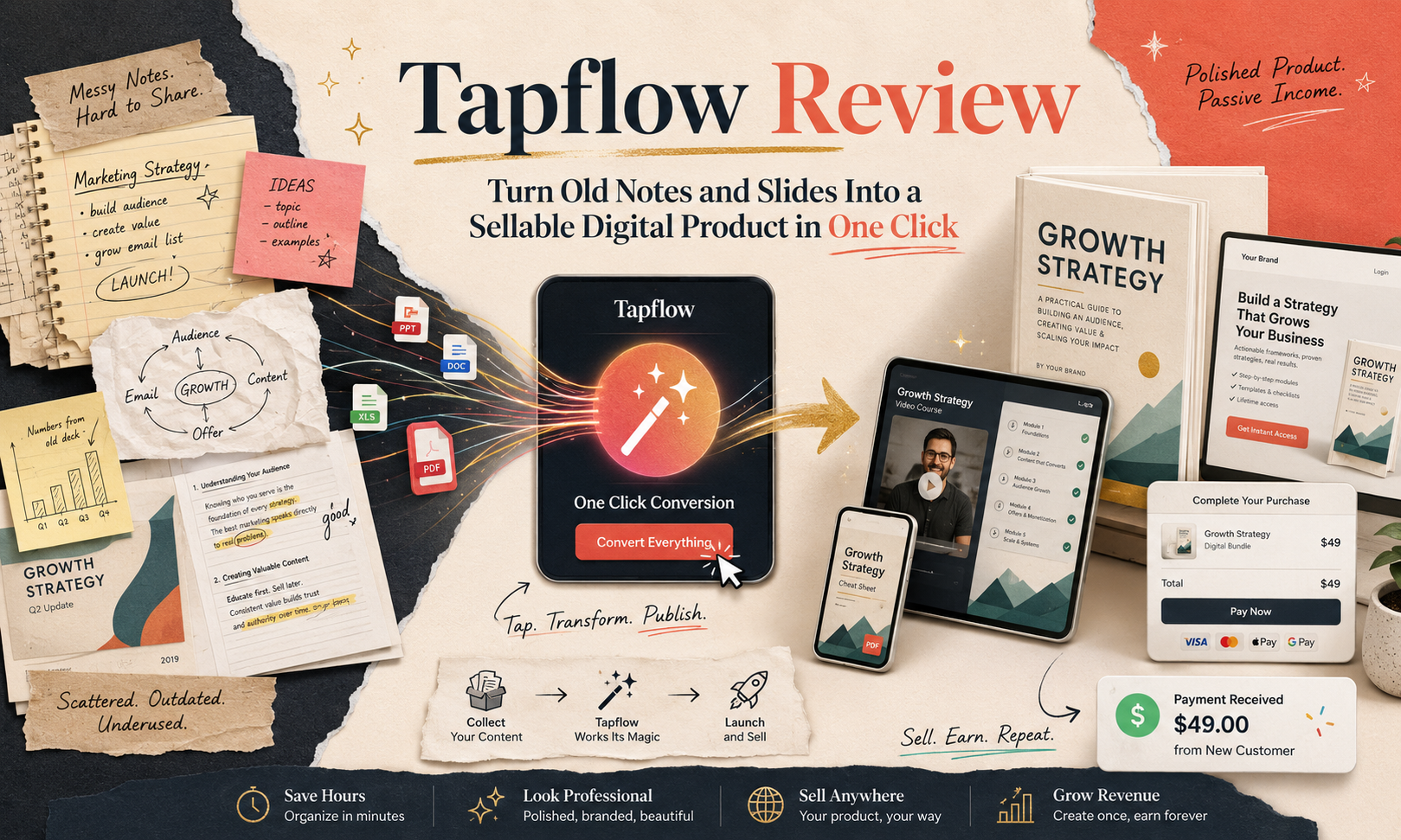
Tapflow Review: Turn Old Notes and Slides Into a Sellable Digital Product in One Click
Here’s a common problem: you have years of notes, slides, prompts, and PDFs sitting in folders. The idea of turning them into a sellable product — a guide, a mini-course, a playbook — usually stalls because formatting a sales page, setting up payments, and designing the delivery feels like a second job.
Tapflow aims to collapse that process into a single click. Drop in whatever you have (messy is fine), and the AI builds a complete product with a sales page, pricing, and Stripe integration. You edit, set a price (free, paid, or pay-what-you-want), and publish.
What The Product Does
Tapflow is an AI-powered platform that repurposes existing content into digital products. According to the product’s description:
• You can upload notes, slides, docs, PDFs, or links — structure doesn’t matter.
• AI generates the product in one click: pages, sales page, and pricing.
• You can edit the result: add videos, files, rearrange sections.
• You choose the price model: free, fixed, or pay-what-you-want.
• Publish immediately or schedule.
• Payments go directly to your Stripe account; you can track sales and revenue.
The core promise is removing friction between having content and selling it. No course platform fees, no landing page builder learning curve.
Why It Matters
The digital product market is crowded, but the barrier has always been packaging, not content. Most creators and professionals have a hidden library of valuable information they’ve never monetized because the effort-to-reward ratio feels off.
If Tapflow works as described, it could lower the starting point for selling knowledge. Instead of spending weeks creating a course structure, you test a product in hours. The seller in the promotional video claimed they sold an old work file for $49 within 6 hours of publishing. While that’s an anecdote, it illustrates a realistic possibility: a single sale can validate whether your archive has demand.
Business Opportunity
The opportunity is not Tapflow itself — it’s the workflow. Anyone with niche expertise or a collection of notes on a specific topic can turn that into a low-effort digital product. Because Tapflow handles the technical packaging, you only need to:
1. Identify a bundle of content that solves a real problem.
2. Drop it into the tool.
3. Set a price and publish.
The margin can be high: no physical inventory, no recurring costs beyond Tapflow’s pricing (currently free to try). If you sell even a handful of copies at $10–$50, the return on time invested is strong.
That said, the market decides. A product about “Turkish address generation” (a common category in Chinese AI side hustle content) might have a narrow audience. Success depends on finding a topic with existing search demand.
Who Could Build Similar Products
• Freelancers with client work templates or reports they can repurpose.
• Course creators who want to test a topic before building a full course.
• Professionals with industry knowledge — consultants, engineers, marketers — who have slide decks or meeting notes.
• Indie hackers looking for a low-code way to launch a digital product without building a SaaS.
The tool itself is closed-source (Tapflow is a proprietary product), but the concept can be replicated: an AI pipeline that takes raw content and outputs a branded sales page + payment integration. If you have coding skills, you could build a similar workflow using LLMs + Stripe + a static site.
Monetization Ideas
1. Single $49 guide — like the example in the video. Pick your highest-value document, clean it up, and price it as a premium resource.
2. Pay-what-you-want lead magnet — use a free or low-cost entry to build an email list, then upsell a deeper course.
3. Bundle multiple files into a “playbook” and charge $97–$197.
4. Offer a service — for $X, you take a client’s raw materials and produce a polished Tapflow product (white-label). This turns the tool into a service business.
The key is to start small and validate pricing. No tool guarantees sales; your niche and the quality of your content determine the outcome.
Key Takeaways
• Tapflow removes the technical friction of packaging digital products. The heavy lift is having content worth selling.
• The claim of a $49 sale in 6 hours is not a guarantee. Treat it as a demo of what’s possible if you have the right audience or SEO.
• This is a product for testing ideas quickly, not a get-rich-quick scheme. Real revenue requires demand creation (marketing, audience, or SEO).
• If you’re sitting on a folder of valuable knowledge, spending an hour with Tapflow is a low-risk experiment.
• For indie builders, the workflow itself (AI content → sales page → Stripe) is a replicable pattern that could be turned into a service or an open-source alternative.
Original video
This article is based on the original YouTube video from Tapflow. Watch the source here: