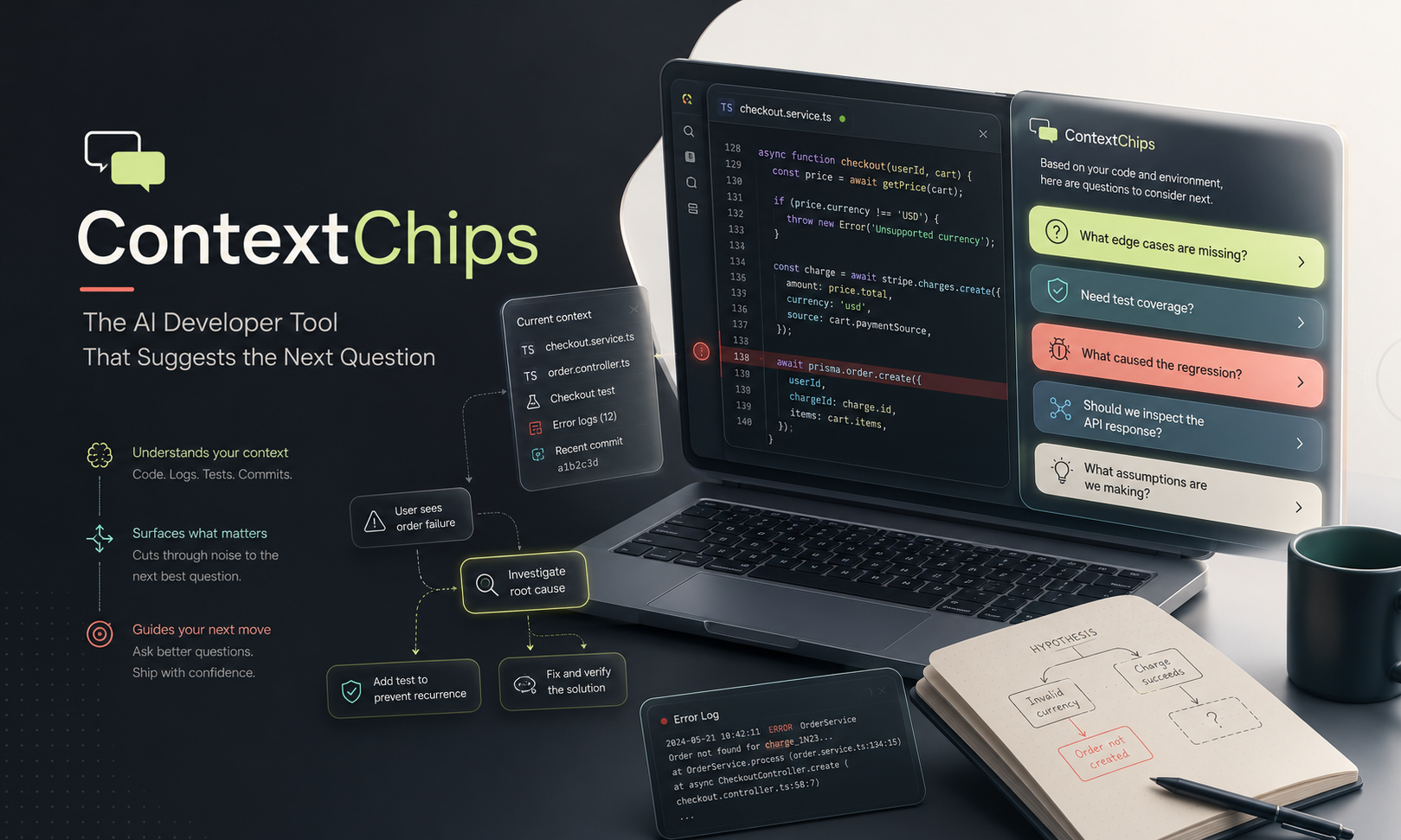
ContextChips: The AI Developer Tool That Suggests the Next Question
What Happened
Shantanu Awate built ContextChips during OpenAI Build Week 2026, a developer infrastructure that solves a persistent problem with AI assistants: after getting an answer, users often don’t know what to ask next. The demo shows a home-repair assistant where ContextChips suggests relevant follow-up questions, helping users move from uncertainty to clarity. A dashboard then surfaces repeated follow-up questions, giving teams insight into where their AI responses fall short.
AI Tools Used
• Codex: Used to design and build the two-phase architecture, API, TypeScript SDK, dashboard, privacy boundaries, and tests.
• GPT-5.6 Terra: Powers the asynchronous reasoning layer that evaluates whether an answer resolved user intent, identifies unmet needs, and converts completed conversations into durable, project-scoped insights.
How It Works
ContextChips operates in two phases. First, after an AI assistant provides an answer, ContextChips analyzes the conversation against past interactions to learn which follow-up questions are commonly asked. It filters out questions that the assistant has already answered and returns up to three relevant next-question chips. The chips are presented to the user as clickable prompts. Second, a dashboard aggregates repeated follow-up questions across all users, enabling teams to pinpoint what users repeatedly need clarified, where AI answers remain unresolved, and which features or explanations to improve next.
Business Opportunity
ContextChips fills a gap in the AI product ecosystem: improving the post-answer experience. For teams building AI chatbots, customer support agents, or educational tools, adding a next-question layer could increase engagement and reduce user frustration. While no pricing or revenue model is disclosed, ContextChips could be offered as a SaaS add-on or embedded directly into existing support platforms. The dashboard analytics also provide actionable product feedback, which has standalone value. However, concrete business details, target customer, and adoption metrics are missing, so this remains an interesting proof-of-concept rather than a proven business case.
Key Takeaways
• AI products often end the interaction too abruptly. A next-question layer can keep users engaged and clarify unclear responses.
• Using AI (like GPT-5.6 Terra) to evaluate intent and surface unmet needs is a smart, practical application of large language models.
• For solo builders and indie hackers, this is a replicable idea: build a lightweight version for a specific niche (e.g., coding help, medical advice, or finance) and test with a simple form of learning from past conversations.
• The biggest uncertainty is whether users will actually click these chips. A/B testing is essential before betting on this approach.
Original video
This article is based on the original YouTube video from Shantanu Awate. Watch the source here: