Varshith Merugu’s video, “How I’d Build a One-Person AI Business From Scratch in 30 Days,” is best read as a practical blueprint, not as proof that anyone can make money in a month. The useful idea is simple: instead of trying to build a complicated SaaS product right away, a beginner can start with a narrow service, use AI tools to move faster, and test whether real customers will pay for a finished result.
For most ordinary people, a service is easier to explain, cheaper to launch, and faster to validate than software. You do not need a team, a large audience, or a polished product. You need one clear customer type, one useful deliverable, and enough reliability to deliver what you promised.
A good example is a solo AI-assisted content service for small businesses. The customer is not paying for raw AI output. They are paying for edited, usable content that helps them show up more consistently: social post drafts, simple blog drafts, email newsletters, product descriptions, or short video scripts.
The simple business idea
Pick one type of small business that already needs content but may not have time to produce it. This could be local fitness studios, independent consultants, Etsy sellers, neighborhood restaurants, accountants, or real estate agents.
Then pick one deliverable. Do not offer “all content marketing.” Start with something small, such as four LinkedIn posts, three product descriptions, one short newsletter, or five short video script ideas. The narrower the offer, the easier it is to sell, deliver, and improve.
AI tools should have specific jobs. ChatGPT or Claude can help with ideas, outlines, drafts, and rewrites. Canva can help with simple visuals. Google Docs or Notion can be enough for delivery. A no-code landing page is optional, not required on day one.
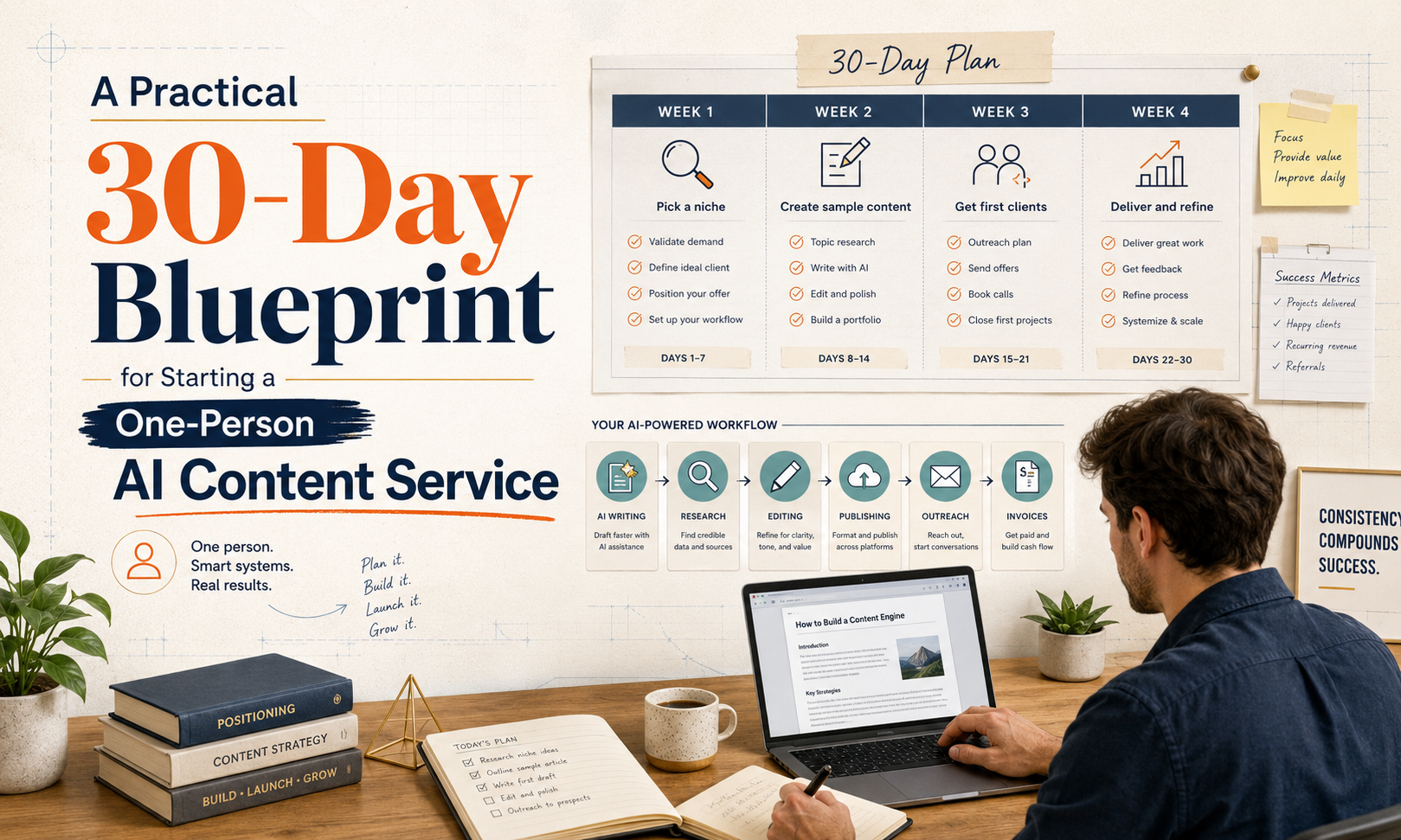
A realistic 30-day plan
Days 1–3: Choose one narrow service
Decide on one customer type, one deliverable, and one clear result. For example: “I help local fitness coaches turn weekly tips into four ready-to-post social media drafts.” That is easier to understand than “AI marketing automation.”
Write down what is included, what is not included, how revisions work, and when the customer receives the work. This prevents the first project from becoming unlimited unpaid labor.
Days 4–7: Build sample work
Create two or three examples before contacting anyone. Show what the customer would receive: draft posts, suggested captions, simple formatting, and maybe a one-page content calendar.
Also write your delivery process: customer sends a short intake form, you draft with AI assistance, you edit manually, you send one Google Doc, and you include one revision.
Days 8–14: Contact potential customers
Customer acquisition is usually harder than creating the content. Start with a narrow list of businesses that visibly have weak, inconsistent, or outdated content. Look at their website, LinkedIn page, Instagram, product pages, or email signup flow. Send a short personal message. Avoid mass spam.
A modest outreach message could be:
Hi Sarah — I noticed your studio posts helpful class updates, but the educational posts seem less consistent. I’m testing a small AI-assisted content service for local fitness businesses. I drafted two example post ideas based on your public class themes. If useful, I can turn this into a one-week content pack with four edited captions and one revision. No pressure either way — happy to send the samples.
Track who you contacted, what you noticed, when you followed up, and what response you received. The goal is not to blast hundreds of strangers. The goal is to learn whether the offer is clear and whether any customer has an urgent enough problem.
Days 15–21: Deliver a small paid trial
If someone is interested, offer a small paid trial instead of a long contract. Keep the scope fixed: one deliverable, fixed quantity, one revision, and a clear deadline. The introductory price should reduce risk for the customer, but not become free work forever.
Delivery should include human judgment. AI can create options, but you still need to check accuracy, remove generic wording, match the customer’s voice, and make the final version useful. If the customer has to rewrite everything, you did not deliver a service.
Days 22–30: Improve the offer
Use feedback to refine the package. Which deliverables were easiest to sell? Which took too long? Which AI prompts helped, and which produced generic filler? Can you standardize intake questions, editing checklists, and delivery templates?
Startup costs
This can be close to zero, but it is more realistic to expect some tool costs if you continue. ChatGPT or Claude may start on a free tier, with an optional paid subscription later. Canva or a similar design tool can begin free, with upgrades only if visual deliverables matter. Google Docs, email, and spreadsheets are usually enough for delivery and tracking. A domain or simple landing page is optional.
Skills required
You do not need to code, but you still need communication, editing, basic research, and reliability. You need to understand the customer’s business well enough to avoid bland AI content. You also need to meet deadlines and handle feedback professionally.
Risks and limitations
This is not passive income. The 30-day timeline is a testing period, not a guarantee. Generic AI content services are competitive, and many customers already know AI tools exist. Your advantage has to be focus, taste, speed, and understanding the customer’s context.
The source video provides a proposed approach, not verified proof of revenue, so readers should treat it as a structure to evaluate and adapt.
Good fit for
This path fits people who are willing to contact potential customers, improve AI output manually, start with one small service, and deliver consistently. It also fits beginners who want to learn business by selling a service before building a product.
Probably not a good fit for
It is probably not a good fit for people expecting immediate passive income, people unwilling to speak with customers, people seeking guaranteed earnings, or people who want AI to do all the work automatically.
Source note
Based on Varshith Merugu’s YouTube video, this article reframes the idea as a cautious, practical blueprint for evaluation.